
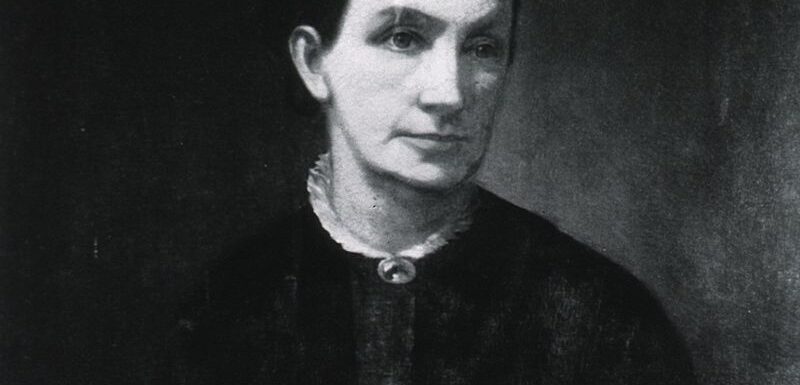
Dr. Ann Preston (1813 to 1872) was an abolitionist, a physician, a women’s rights advocate, and a children’s book author.
Early Life
Born into a Quaker family, she became interested in hygiene and medicine while tending her dying mother and sister. As the eldest, she took responsibility for raising her six brothers. During this time, she also experienced the cruelty of slavery firsthand. Her father’s farm in West Grove, close to the Delaware border, was associated with the Underground Railroad. As a young girl she helped hide fugitive slaves and agonized when runaways were recaptured by slave catchers. This experience compelled her to fight for human rights all her life and to serve as secretary of the Clarkson Anti-Slavery Society Association which predated the Anti-Slavery Society.
Although she only attended grade school, she educated herself through the public library and through the intellectual and moral discussions in her home and community. She was a life-long learner, later teaching herself Latin.
In 1838, she was present at the dedication of Pennsylvania Hall when it was burned by a mob, after which she wrote and published a poem, expressing her outrage, “The Burning of Pennsylvania Hall.”
In 1849, she wrote and published Cousin Ann’s Stories, a children’s book of morality tales. The book includes the story “Tom and Lucy” about a family of slaves being separated and sold, and the story of Henry Box Brown, who escaped slavery by shipping himself in a two-foot by three-foot crate to Philadelphia. There is also a story with children including a black girl in their play.
While she was writing this storybook, Ann Preston was also studying to be a doctor. Denied entrance by four medical colleges in Philadelphia, she became a student of Dr. Nathaniel R. Mosely and received practical clinical training.
At this time, at the instigation of her friend, Lucretia Mott, William Mullen, a rich businessmen, and Dr. Joseph Longshore set up a charter for a women’s medical college, which became the Female Medical College of Pennsylvania (now part of Hahnemann Medical College).
Mullen leased two rooms at 229 Arch Street and paid for medical equipment for the school. The goal was to provide training equal to that of the medical colleges for men. The program included two years of study with a doctor and two two-month sessions at the college. The first faculty were men who gave the lectures.

A tiny woman who suffered her whole life from the effects of rheumatic fever, Ann Preston, at the age of thirty seven, applied to the first class and with seven others worked toward a degree. In 1851, she was awarded her doctorate.
She stayed on for another year of study and then was named an instructor in physiology and hygiene. In her course, she emphasized prevention, believing exercise, good air, and diet were better treatments than any medicine. She encouraged her students to read medical research and to keep accurate detailed records to add to what was known.

But despite having a degree, Preston, along with the other women graduates, was ridiculed and attacked by the male medical establishment. Despite their training, women doctors were not allowed to practice medicine in the city hospitals.
Angry over the lack of clinical training for female medical students, Preston worked on opening Women’s Hospital for Women and Children of Philadelphia in 1861. She established the innovation of having several doctors sleep at the hospital in case of emergencies. In addition, she started a training program for nurses.
Not satisfied with this success, she fought for the right of women patients to be able to choose a female doctor if they wished, and she continued to work on opening all the city’s hospitals to women doctors. Elected Dean of Faculty for the Women’s Medical College in 1866, she fought on every level to remove the prejudice against women physicians. She wrote, “We must protest…against the injustice which places difficulties in our way, not because we are ignorant or incompetent or unmindful in the code of medical or Christian ethics, but because we are women.”
She went on to serve nineteen years as Professor of Physiology and Hygiene, six years Dean of the Faculty, and four years as member of the Board of Corporators. During this time, she continued to fight for the right for women to do clinical practice at all hospitals and to attend medical conferences and join medical associations.
Her student, Dr. Eliza Judson, in her memorial address on Preston’s death in 1872, wrote the following description of her: “Mentally and morally so strong to do and bear, yet personally so childlike in her dependence upon others; courageous and hopeful where strong men faltered, she was one of the gentlest and most affectionate of women; and proved it no Utopian dream, that a woman may be both strong and womanly.” (p. 25)
Ann Preston willed her life savings to the college to continue the work she had started. By the time of her death, one-hundred-and thirty-eight women had graduated as doctors from Women’s Medical College, including: Dr. Anna Elizabeth Broomall, Dr. Rebecca J. Cole, Eliza Ann Grier, Mary Putnam Jacoby, and Dr. Hannah Longshore, a close friend and supporter of the orator, Anna Dickinson.
The following two excerpts from Ann Preston’s journal are quoted in Dr. Judson’s memorial address and give a more intimate view of this amazing woman:
(n.d.) –“Two ideas I have had of the perfection of physical pleasure. One was eating strawberries and cream, which have always seemed to me akin to the nectar and ambrosia of the gods; the other was sailing in a little boat, away down, down a smooth stream. During the past week I have had my full satisfaction of both and find them closely allied to vanity and vexation of spirit.” (p. 17)
~*~*~*~
“Oct. 8th, 1861. — I have been sad for my country, because it is so slow to learn the wisdom which would bring prosperity; sad for my disabled mother and desolate home; sad in the prospects of the Institution to which I have given so much of my time and strength, for there now seems no possibility of success; and I fear that, after all these years of toil, we may be doomed to succumb to the weight of opposition. But even now, when the burden of this disappointment is heaviest, there is consolation in the conviction that this labor has not been wasted — that, perchance, it is the needful preliminary to a more prosperous endeavor — that no true, right work like this can be in vain, although it may be regarded by the world as a failure. Tonight the inward encouragement is, do thy best; work where the work opens ; applauded or condemned, speak and write thy grandest inspiration, thy noblest idea, and sing hosanna, for thy work has been no failure, and the Everlasting will preserve it, and attest it forever.” (p.19)
Writings by Ann Preston
- 1842 Poem, “The Child’s Playhouse”, 1842
- 1843 Poem, “To a Departed Sister”, 1843
- Cousin Ann’s Stories for Children (Philadelphia, J.M. McKim, 1849; re-issued 2011) https://dmr.bsu.edu/digital/collection/chapbks/id/924/rec/1
- 1855+ Addresses and lectures (including an introductory lecture, 2 valedictory addresses, and “Women as Physicians”, 1855, 1858, 1867, 1870.
- 1859 Introductory Lecture to the Class of the Female Medical College of Pennsylvania by Ann Preston, October 19, 1859.
- n.d. Poem, “It’s Good to Live. A Thanksgiving Hymn”
- n.d. Poem, “Remember Me When Far Away”
For a discussion of Preston’s children’s book see: The Slave’s Little Friends: American Antislavery Writings for Children edited by Carme Manuel, 2022, pp. 62-64.
Learn more about Ann Preston
Address in memory of Ann Preston, M.D.: delivered, by Dr. Eliza E. Judson at the request of the corporations and faculty of the Woman’s Medical College of Pennsylvania, March 11th, 1873
Eminent Women of the Age: Being Narratives of the Lives and Deeds of the Most Prominent Women of the Present Generation. 1869 By James Parton pp. 544- 550.
“Ann Preston, M.D.: An Excursus.” In A New and Untried Course: Woman’s Medical College and Medical College of Pennsylvania 1850-1998 by Steven Jay Peitzman 2000 pp. 45-48.
“Dr. Ann Preston” NIMH U.S. Library of Medicine.
“Ann Preston” Quakers in the World.
“It is no Utopian dream that it is possible to live truthfully and generously in this world. The cynic and worldly may sneer at the simplicity that believes and trusts in humanity; but the right-minded and prudent who habitually appeal to the best in others, find that best respond; those that trust in the right, find a sure defense. It has been well said, “One on the side of God is a majority.”
Dr. Ann Preston
in her Introductory Lecture 1859