
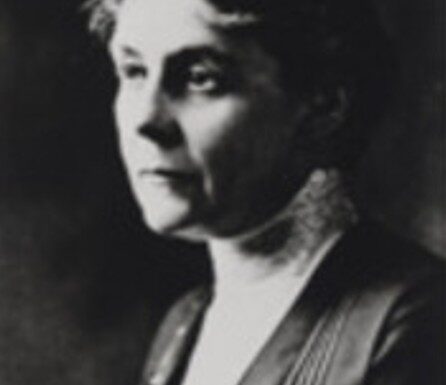
Educator, biologist, public health and women’s rights advocate Ida Henrietta Hyde (September 8, 1857, to August 22, 1945) was born in Davenport, Iowa, into a German-speaking immigrant family.
Ida Hyde’s Early Life
When she was young, her father abandoned her mother and four siblings. In 1871, the Chicago fire destroyed the family home, and as the oldest sibling, she became the breadwinner at age fourteen, working in a clothing factory and as a milliner. During this time, she paid for her only brother’s tuition at the University of Illinois and also took evening classes from 1875 to 1876.
During this period, she read The View of Nature by Alexander von Humboldt and fell in love with biology. This would determine the direction of her life’s work. Driven to learn more, at the age of twenty-four, she enrolled in the University of Illinois. But when her brother fell ill, she dropped out to nurse him, using up her savings. With no money for college tuition, she became an elementary school teacher in Chicago, where she taught third and fourth graders and established the “Science in the Schools” program. However, she never gave up her dream of being a biologist. All during this time, she saved towards obtaining a college degree.
The Struggle for Education
In 1888, at age thirty-one, Hyde enrolled at Cornell University and, in three years, earned her BA in biological science. This was followed by a scholarship to study biology at Bryn Mawr. While there, she became the first woman to do research at Woods Hole Marine Biology Lab.
In 1893, her study of the nervous system of jellyfish at Woods Hole led to an invitation to come to the University of Strasbourg. There, Hyde became the first woman in Germany to petition to be matriculated for an advanced degree in science. When Strasbourg refused to accept a woman, she enrolled at Heidelberg University, where, at the age of thirty-nine, she received her doctorate. Her thesis project was on the physiological development of jellyfish.

She was the first woman to receive a research scholarship to the Naples Zoological Institute in Italy. She also studied and taught at the University of Bern. She returned to the United States to teach at the University of Kansas. Not satisfied, she attended Rush Medical College and earned her M.D. in 1911.
Accomplishments
In Science Over her career, Hyde studied a wide range of biology topics, including the mammalian heart, the physiology of invertebrates and vertebrates, and the effects of caffeine, narcotics, and alcohol on the human body.
She invented a restraining device for octopuses. In one famous incident, a sedated octopus became active during a visit by the Kaiser, president of the Prussian Society for the Prevention of Cruelty to Animals. The Kaiser threatened to withdraw funds from the institute until Hyde convinced him it was a reflex movement and not animal torture. Hyde wrote up the whole encounter as ‘When the Kaiser met the Devil Fish’ for The New York Evening Post in 1917.
Ida Hyde is most cited today for her invention of a micropipette electrode that could stimulate tissue chemically or electronically but was tiny enough to inject or remove tissue from a cell. It was never officially attributed to Ida, but today it is agreed that she was the first.

In 1902, she became the first woman inducted into the American Society of Physiologists and was the only female member until 1913.
In Public Health In addition to her biological research, Hyde was concerned about public health, especially in schools. In Kansas, she initiated medical examinations of schoolchildren for communicable diseases, like tuberculosis and spinal meningitis. She conducted classes in health and sex education in public schools. She was appointed State Chairman of the Kansas Women’s Committee on Health, Sanitation, and National Defense in 1918.
For Women’s Rights From a young age, Ida experienced setbacks due to her gender, so it is natural that throughout her life, she fought for access for women to higher education and support for their scientific investigations, as well as for equal opportunity and women’s restrooms in college buildings, which had only those for men.
In 1898, Ida Hyde organized a group of women to fund a “woman’s table” at the Naples Zoological Station and also to issue a thousand-dollar prize for the best thesis written by a woman. She also established scholarships at the University of Kansas. To the Association of American University Women, she endowed twenty-five thousand dollars for an Ida H. Hyde Women’s International Fellowship.
The following excerpts are from “Before Women Were Human Beings,” which tells the story of her battle for an advanced degree in biology in Germany.
۞۞۞
Adventures of an American Fellow in German Universities of the ‘90s (1890s)
by Ida H. Hyde
Early in the last decade of the nineteenth century, a polemic between two European professors pertaining to the development of an organism they were investigating led to a bitter personal criticism that finally appeared in print. The controversy aroused the interest of embryologists in this country, particularly a student at Bryn Mawr College, who without knowing of these professors, was conducting experiments on the very problem about which the dispute centered.
The results obtained by the student in her investigation corroborated those published by one of the disputants. Professor Goette was informed of this fact, and he was very much elated. Eager to have his interpretation of the results strengthened and the investigation of the problem variously extended, he invited the student to come to the University of Strasbourg and continue her study of the subject in his department.
At the time the European Fellowship was awarded, it was not known to my professors nor to me that universities in Germany were not coeducational institutions and that women had never studied at the University of Strasbourg; in fact, they had not been permitted to matriculate in any German university. Therefore, we on this side did not appreciate the full significance and importance of the departure when Professor Goette, director of the Zoology Department at the University of Strasbourg, graciously invited a woman student of Bryn Mawr College to work in his department.
This invitation came to me as a complete surprise. Unfortunately, it seemed impossible at the time to accept the tempting suggestion. But suddenly a way was unexpectedly opened through the splendid offer of the European Fellowship awarded in 1893 by the Association of Collegiate Alumnae for study in foreign universities. Thus, in a short space of time and in a most extraordinary manner, the realization of the dream to work in the promised halls of Strasbourg University became a reality.
۞۞۞
It was not until I had worked many days in the splendid laboratory assigned to my private use that it dawned upon me that I was occupying a unique position and that I was regarded by the students, faculty members, and their wives as a curiosity. In the university circle, the news quickly spread that an American “woman’s rights” freak, a blue stocking and what not, had had the boldness and audacity to force entrance into the college halls. At Kaffee Klatchen she was served for gossip and dissection. It was not unusual for a professor, student, or diener(1), seemingly by mistake, to open the laboratory door, look frightened, and quickly retreat. Or students would congregate at the windows of the botanical building opposite the laboratory, and from sheer curiosity stare across at my windows, greatly to the annoyance of the professors in both buildings…
۞۞۞
[She then explains all the steps she had to take to obtain permission to study for a Ph.D., finally receiving royal permission from the Grand Duke of Baden. She goes on…]
It may be imagined with what profound gratitude and appreciation I received these tidings. They established for the first time in the history of this institution the significant and victorious outcome of the struggle to gain recognition for women candidates for the Ph.D. degree. As a consequence, women thereafter met few obstacles in entering any – except the medical – department at the University of Heidelberg.
Although equal opportunities with men students were not obtained, nevertheless, a beginning was made toward that end. With the passage of the decree any woman prepared to fulfill the university’s requirements was permitted to study for the finals, and if successful obtain the doctor’s degree.
۞۞۞
HER WRITINGS
“Notes on the Hearts of Certain Mammals.” The American Naturalist 25(298), 1891, pp. 861–863. JSTOR2451734
“The Effect of Distention of the Ventricle on the Flow of Blood through the Walls of the Heart.” American Journal of Physiology, 1898.
“The Nervous System in Goneomea Murbachii.” Biological Bulletin 4(1), 1902, pp. 40–45. JSTOR1535511
Outlines of Experimental Physiology. University of Kansas, 1905.
“The Influence of Alcohol on Reflex Action in the Frog,” with Ruth Spray & Irene Howat. Journal of the Chemical Society, vol. C1 & C2, 318, 1912.
“The Kaiser and the Devilfish.” The New York Evening Post Magazine, May 25, 1918. Reprise in The Literary Digest, 17:28-29, 1918.
“A micro-electrode and unicellular stimulation.” Biological Bulletin, 40:130–133, 1921.
“Effects of music upon electrocardiograms and blood pressure.” Journal of Experimental Psychology, 7:213–224, 1924.
“Before Women Were Human Beings: Adventures of an American Fellow in German Universities of the ‘90s.” New York Evening Post Magazine, 1938.
REFERENCES
The Biological Stations of Europe, by Charles Atwood Kofoid, Department of the Interior, Washington, 1910.
“Ida Henrietta Hyde.” https://www.theguardian.com/science/the-h-word/2013/sep/08/ida-henrietta-hyde-anniversary-physiologist
“Ida Henrietta Hyde: A trailblazer in physiology.” https://ispyphysiology.com/2017/03/01/ida-henrietta-hyde-a-trailblazer-in-physiology/
“Although equal opportunities with men students were not obtained, nevertheless, a beginning was made toward that end.”
Ida Henrietta Hyde