
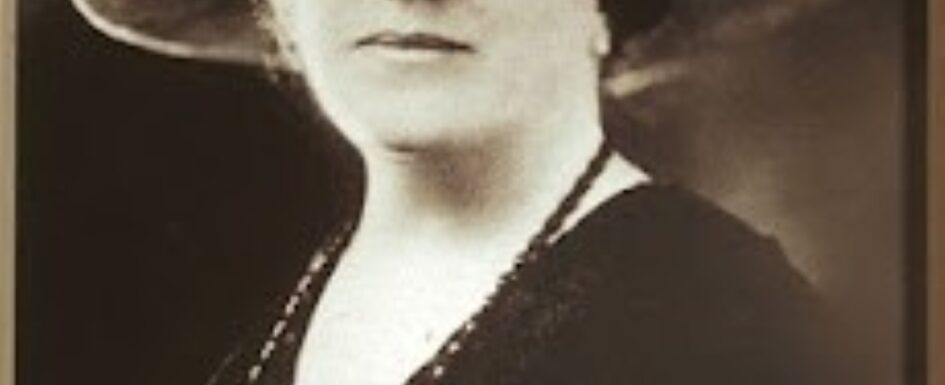
Margaret Lillian Foley did not enter history through a parlor door. She came in through the factory gate.
She Trimmed Hats
Margaret Foley ( February 19, 1873 – June 14, 1957) was a labor organizer, social worker, and powerful advocate for women’s right to vote. Born into a working-class Irish-American family in Boston, this American suffragette started out trimming hats, not sipping tea in drawing rooms. Her wages from the hat factory bought her more than food and rent; they bought singing and dancing lessons. She trained her voice in the margins of long workdays, probably with sore feet and tired eyes, but a stubborn belief that her voice and presence could carry her further than any assembly line ever would.
There is something wonderfully subversive about that choice. In an era when a working woman’s world was supposed to be narrow and obedient, Margaret invested in voice and movement, the tools of presence and disruption.
For a short time, she tried something different. During a stay in California, she taught gymnastics and swimming, training bodies to be strong and unafraid of deep water. It’s tempting to see this as symbolic: the woman who would later descend into mines and rise in hot-air balloons first learned to move confidently through challenging spaces. But California was a brief interval. Boston, with its mills, its unions, and its sharp politics, called her home.
On returning to Boston, Margaret joined the Hat Trimmers Union, and from there, the Boston Women’s Trade Union League. These weren’t genteel clubs; they were rooms where working women debated wages, hours, and dignity. And it was from this crucible of labor organizing that she stepped into the broader suffrage movement, employed from 1905 to 1915 by the Massachusetts Woman Suffrage Association to travel the state giving speeches and distributing pamphlets.
She Took the Suffrage Message to the Masses
Margaret was not a parlor lecturer. She was an open-air orator.
Using her trained “silver-tongued voice,” solid physical presence, and quick wit, she spoke from street corners, rooftops, and fairgrounds to crowds who did not necessarily plan to hear her, much less agree with her. In 1910, she famously went aloft in the open basket of a hot air balloon over the Lowell fairgrounds, 800 feet into the sky, and scattered suffrage leaflets over the crowd below. It was part spectacle, part wake-up call. She understood something essential: people listen better when you first make them look up.


After attending the International Woman Suffrage Convention in Stockholm in 1911, she traveled to London to study the British suffragette movement. There she found women heckling, interrupting, marching, and refusing to stay in their assigned places. This, she recognized, was a language she spoke fluently.
Between 1912 and 1918, Margaret crisscrossed the United States on speaking tours. Unlike many of her middle- and upper-class colleagues, she was at ease with working people and rough settings. She addressed miners in Virginia City, Nevada, not from a podium but 2,000 feet down a mine, wearing a miner’s shirt and pants. She faced down male audiences at the Stock Exchange, the Chamber of Commerce, and Tammany Hall. These were not polite literary societies; they were engines of money and power, used to the sound of male voices echoing in their chambers. Into that closed world, Margaret injected questions, challenges, and sharp, impossible-to-ignore one-liners.
This is where she earned the title of “The Great Heckler” and “Arch-Quizer.”

She Made Heckling an Art Form
For Margaret Foley, heckling was a strategy. She would attend political rallies, often the only woman in a sea of men, and wait for exactly the right moment to rise, then shout a question the speaker could not easily dodge.
Think of the stakes: there is a crowd, a male politician, a carefully prepared speech about taxes or “good government.” The normal pattern is that men speak and the women, if present at all, applaud politely or stay silent. Suddenly, Margaret stands and cuts across that entitled male voice, forcing the speaker to answer: If women pay taxes, why do they not vote? If working girls help build these cities, why are they treated as children in the law?
She was called “The Great Heckler” because she understood the power of interruption. A shouted question can puncture a balloon of rhetoric more quickly than any reasoned editorial the next day. It can turn a one-sided performance into an argument. And once there is an argument, the audience must decide where they stand.
Her heckling, however, did not endear her to everyone on her own side. Many suffrage leaders came from more privileged backgrounds and favored careful, “ladylike” persuasion over confrontation. Elizabeth Cady Stanton, for example, believed the vote should be restricted to literate, educated women. This view sat uneasily next to Margaret’s insistence that factory girls deserved a voice in how their lives were governed.
Margaret’s own words were clear and uncompromising:
“Some men say that they think a tax-paying woman should have the ballot. I contend that the poorest factory girl is helping pay the taxes, and she should have a right to say something about the care, fire protection, and sanitary condition of property.”
Source: “Attacks Gov Foss.: Miss Foley Says When Women Vote They Will Not Forget 54-Hour Bill, at Meeting on Common,” Boston Daily Globe, August 30, 1911.
In that short statement, you can feel her roots: the hat factory, the union halls, the boardinghouses with thin walls and poor plumbing, the constant awareness that the people with the least power lived with the greatest risk from fire, sickness, and neglect. She dragged the suffrage question out of drawing rooms and into the tenements and factory floors where “property” meant not portfolios but the buildings women cleaned, the machines they operated, the streets their children played in.
Her bold tactics often clashed with the Massachusetts Woman Suffrage Association itself. They called her “unladylike” and a “trouble-maker.” She fought with them over delayed pay and travel expenses: conflicts that sound petty until you remember how precarious a working woman’s finances could be. Her bold voice and direct attacks on men within the movement made her doubly suspect: she was working-class, Irish-American, loud, and unwilling to pretend that all women were treated equally or that all women’s voices were welcomed. It has been said that she was personally responsible for the defeat of numerous anti-suffrage candidates.
Most of her speeches were never published. That loss is more than historical inconvenience; it is a reminder of how often the voices of working women are allowed to ring out in the moment but not preserved on the page. What survives of her public image is often filtered through adversaries, including, ironically, the anti-suffrage journal, The Remonstrance, which, in a 1915 article, “Wooing the Saloon Interests,” quoted her to frame suffragists as underhanded. Even in opposition, though, they testified to her presence. One does not devote column inches to a woman whose words fall flat.
“While most of the suffrage orators try to convince the people that woman suffrage would bring about a “moral uplift,” and especially that it would strengthen the forces of temperance, Miss Margaret Foley seems to have been told off to reassure saloon interests and to persuade them that they have nothing to fear from women’s votes.
This was the tenor of her street corner talks in New Bedford, Gloucester, and other cities last summer, when she told men who gathered to listen to her that “no one was going to take away their beer.” It was her main theme in her campaign in Nevada; and she evidently succeeded in persuading voters that suffrage had no connection to prohibition, else the state which has more saloons in proportion than any other state in the Union would hardly have cast its vote for woman suffrage.” p. 9.
So What Does Margaret Foley Teach Us about Heckling?
She shows us that heckling, in its most serious form, is not about theatrics or insult. It is about refusing to let power speak unchallenged. It is the voice from the back of the room that won’t accept “that’s just how it is.” In her hands, heckling became an act of care for the women who could not afford to travel to rallies, who were too tired from double shifts to attend meetings, but who still deserved a say in fire protection, sanitation, and all the acutely practical matters of daily survival.
She understood that silence is comforting only for those already comfortable. For everyone else, sometimes comfort begins with discomfort. It starts with a question that stops the polished speech in its tracks, and continues with a voice that insists the poorest factory girl is already paying the price, and must be allowed to speak.
Margaret Foley never gave up working for the better good. From 1913 to 1920, she served as a Trustee for Children in the Boston City’s Children’s Institutions Department and from 1920 to 1926 as a deputy commissioner of the Child Welfare Division in the Institutions Department. She never married but lived in a loving relationship with Helen Elizabeth Goodnow, a fellow fighter for women’s votes, from the mid-1920s until her death in 1957.
Learn More About Margaret Foley and the American Suffrage Movement
Margaret Foley’s Papers (1847-1968) are available at the Schlesinger Library, Radcliffe Institute, Harvard University
See also the following articles:
1911 “Spectacular Woman Suffrage in America” The Independent, Volume 71, p. 808.
1914 “Women’s Parade.” Life and Labor: A Monthly Magazine, Volume 4, p. 177.
1914 The Land of Sunshine. This whole issue is about Nevada’s suffrage movement.
1916 “A Look Forward and Back at the Woman’s Journal” by Agnes E. Rya, Women’s Journal and Suffragette News.
1927 “Campaign for Ratification” Commonwealth History of Massachusetts, Colony, Province and State: Twentieth century Massachusetts, 1889-1930, edited by Albert Bushnell Hart.
Articles about Margaret Foley
“Margaret Foley.” Boston National Historical Park. National Park Service, 2023.
“Margaret Foley: The Life and Legacy of a Queer Suffragette” by Emma Quirk, Power in Place. Summer 2023,
“Boston Irish-Americans to Remember: Suffragist Margaret Foley” by Jenna Connolly, Very Local, April 15, 2022.
Savvy Strategists & Innovative Advocates: The Story of Massachusetts’ Suffragists, Massachusetts Women’s History Museum
Have you ever heckled a speaker?